US-Iran talks conclude in Switzerland amid US threats and Iranian delegation walkout; upcoming technical talks a critical juncture: Chinese expert
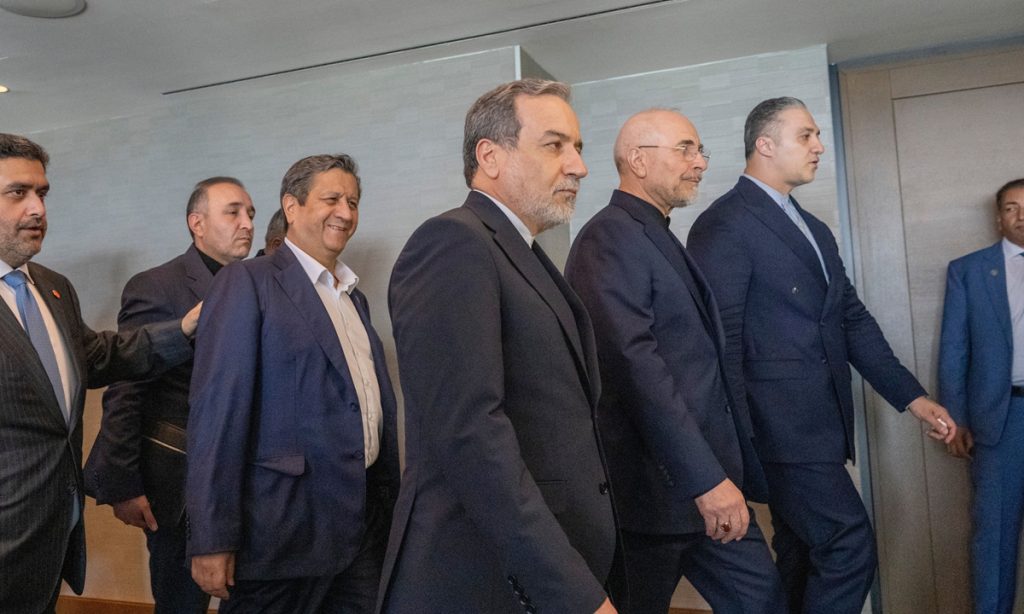
US-Iran talks in Switzerland underwent twists and turns amid threats from US side and an Iranian delegation walkout. Mediators Qatar and Pakistan called high-level talks concluded on Monday positive and constructive. Both sides agreed to set up a de-confliction cell to resolve hostilities in Lebanon, with lower-level talks scheduled for the rest of the week.
"China supports the mediation efforts by parties including Pakistan and Qatar. We hope Iran and the US will keep the talks going, further narrow differences and strive for good progress in their negotiation," Chinese Foreign Ministry spokesperson Guo Jiakun said on Monday, when asked to comment on that Iran and the US agreed Monday to set up communication lines to keep the Strait of Hormuz open and end fighting in Lebanon, according to mediators, Pakistan and Qatar.
US-Iran negotiations concluded constructively in Switzerland overnight and technical talks will continue this week, according to mediators, after US President Donald Trump's threats stalled progress. At one point, an Iranian source told CNN talks had stalled after Trump took aim at Iran in an interview with Fox News. Trump threatened to resume bombing Iran and take over the Strait of Hormuz, saying "If they don't make a deal, we'll collect tolls."
Iranian foreign ministry spokesperson Esmaeil Baghaei said Iran initially refused to continue after Trump's threats were aired, according to state media, per CNN.
But high-level negotiations continued before concluding in the early hours of Monday, with Pakistan and Qatar saying technical talks between the two sides would continue for the rest of the week, said the report.
Moreover, after round one of the talks concluded, the Iranian delegation refused to take part in a planned handshake and joint photo opportunity with American officials, according to the FirstPost.
Video footage shared by Iran's semi-official Tasnim News Agency showed the Iranian delegation leaving the conference room ahead of the scheduled media event with the US side. According to Iran's state news agency IRNA, the delegation exited the venue after the meeting owing to Trump issuing threats on social media.
According to one report, Pakistan's Shehbaz Sharif was shocked at the walkout and then sent the country's Interior Minister Mohsin Naqvi with the Iranian team as he discussed the matter with another key player, Pakistan's army chief Asim Munir, per FirstPost.
Later on Monday, mediators Pakistan and Qatar said the US and Iran agreed to establish a High Level Committee to provide "political oversight on the mediation." Negotiators reporting to the committee will lead groups focused on nuclear issues, sanctions, and other means to implement the US-Iran agreement, the mediators said in a joint statement, according to CNN.
The mediators also said "encouraging progress" had been made in the talks — a surprising outcome after a long stretch of uncertainty.
A statement from mediators Pakistan and Qatar said the cell would include the Lebanese government and would "ensure the adherence of the termination of military operations in Lebanon." But it remains unclear whether that will be enough to stop fighting between the Hezbollah and Israel, which occupies Lebanon and insists it must maintain a free hand to attack militants who are launching attacks into northern Israel, according to the Associated Press.
The talks marked the start of a 60-day diplomatic process that seeks to reach a permanent deal to end the Iran war. But the fighting in Lebanon remains one of the key sticking points, according to AP.
Iran's foreign minister has shared a post responding to Pakistan and Qatar's statement. "Tireless Pakistani and Qatari mediation has delivered major progress to end Lebanon War," Seyed Abbas Araghchi wrote on X.
"Oil and [petrochemical] exports are waived, blockade lifted, some frozen assets released, and major reconstruction and development plan launched for Iran," he added. However, he concluded by saying that the first "real test" will be the "Lebanon deconfliction cell."
Iranian President Masoud Pezeshkian said that his government entered the ongoing negotiations "with dignity and pride, without backing down," and described the outcome of this process as creating "good openings" in trade and investment, according to Iran Wire.
According to ISNA, speaking on Monday at the National Guilds Day ceremony at the Tehran Summit Hall, Pezeshkian said the negotiation process progressed in such a way that "we signed off on all the clauses we expected," and that the Islamic Republic "will not back down or bow down" when its rights are ignored.
Also on Monday, US Vice President JD Vance said that the Strait of Hormuz is open and crude oil and natural gas are flowing through. "We wanted to build a mechanism for keeping the Strait of Hormuz open. It is open," said Vance as he delivered remarks after the first session of US-Iran talks concluded at central Switzerland's Buergenstock resort, Xinhua reported.
Pakistani Prime Minister Shehbaz Sharif wrote on X on Monday that the First High-Level Committee Meeting under the framework of the Islamabad Memorandum of Understanding has concluded successfully in Burgenstock, Switzerland. The discussions were held in a positive and constructive atmosphere and yielded encouraging progress, including agreement on a roadmap toward a final deal within 60 days, the establishment of a High-Level Committee to provide political oversight, and the commencement of further technical talks.
Pakistan will continue to play its honest and sincere role in advancing dialogue and diplomacy towards a peaceful and lasting resolution, he added.
Sun Degang, director of the Center for Middle Eastern Studies at Fudan University, told the Global Times on Monday that the upcoming technical talks are a critical juncture. The true test of this mediation hinges on four seemingly irreconcilable pillars: the jurisdictional battle over the Strait of Hormuz, the concrete timeline for unfreezing Iranian assets, the nuclear material transfers, and a viable exit strategy for the ongoing conflict in Lebanon, Sun added.