Some birds of paradise really know how to work their angles. Tilted, microscopic filaments in some of the showy birds’ black feathers make that plumage look much darker than traditional black feathers, researchers report online January 9 in Nature Communications.
Dakota McCoy, an evolutionary biologist at Harvard University, and colleagues measured how much light each type of black feather absorbs. Superblack feathers absorb up to 99.95 percent of light that shines directly on them, while traditional black feathers absorb up to 96.8 percent, the researchers found. Using scanning electron microscopy and nano-CT scanning, the team observed that ultrablack feathers have ragged, spike-studded barbules that curve upward at a roughly 30-degree angle to the tip, creating an array of deep, curved cavities. Traditional black feathers are smoother and lack such detailed microstructures. These spikes and pits scatter light multiple times, allowing for more light absorption and darker plumage, the scientists say. Even when the researchers dusted the feathers with gold, the darkest ones still retained their blackness, while traditional black plumes looked gilded in SEM images.
Superblack patches probably evolved to “exaggerate the perceived brilliance of adjacent color patches” during mating displays, the researchers write.
“The strangest place in the whole universe might just be right here.” So says actor Will Smith, narrating the opening moments of a new documentary series about the wonderful unlikeliness of our own planet, Earth.
One Strange Rock, premiering March 26 on the National Geographic Channel, is itself a peculiar and unlikely creation. Executive produced by Academy Award–nominated Darren Aronofsky and by Jane Root of the production company Nutopia and narrated by Smith, the sprawling, ambitious 10-episode series is chock-full of stunningly beautiful images and CGI visuals of our dynamic planet. Each episode is united by a theme relating to Earth’s history, such as the genesis of life, the magnetic and atmospheric shields that protect the planet from solar radiation and the ways in which Earth’s denizens have shaped its surface. The first episode, “Gasp,” ponders Earth’s atmosphere and where its oxygen comes from. In one memorable sequence, the episode takes viewers on a whirlwind journey from Ethiopia’s dusty deserts to the Amazon rainforest to phytoplankton blooms in the ocean. Dust storms from Ethiopia, Smith tells us, fertilize the rainforest. And that rainforest, in turn, feeds phytoplankton. A mighty atmospheric river, fueled by water vapor from the Amazon and heat from the sun, flows across South America until it reaches the Andes and condenses into rain. That rain erodes rock and washes nutrients into the ocean, feeding blooms of phytoplankton called diatoms. One out of every two breaths that we take comes from the photosynthesis of those diatoms, Smith adds. As always, Smith is an appealing everyman. But the true stars of the series may be the eight astronauts, including Chris Hadfield and Nicole Stott, who appear throughout the series. In stark contrast to the colorful images of the planet, the astronauts are filmed alone, their faces half in shadow against a black background as they tell stories that loosely connect to the themes. The visual contrast emphasizes the astronauts’ roles as outsiders who have a rare perspective on the blue marble. “Having flown in space, I feel this connection to the planet,” Stott told Science News . “I was reintroduced to the planet.” Hadfield had a similar sentiment: “It’s just one tiny place, but it’s the tiny place that is ours,” he added. Each astronaut anchors a different episode. In “Gasp,” Hadfield describes a frightening moment during a spacewalk outside the International Space Station when his eyes watered. Without gravity, the water couldn’t form into teardrops, so it effectively blinded him. To remove the water, he was forced to allow some precious air to escape his suit. It’s a tense moment that underscores the pricelessness of the thin blue line, visible from space, that marks Earth’s atmosphere. “It contains everything that’s important to us,” Hadfield says in the episode. “It contains life.”
Stott, meanwhile, figures prominently in an episode called “Storm.” Instead of a weather system, the title refers to the rain of space debris that Earth has endured throughout much of its history — including the powerful collision that formed the moon (SN: 4/15/17, p. 18). Stott describes her own sense of wonder as a child, watching astronauts land on our closest neighbor — and how the travels of those astronauts and the rocks they brought back revealed that Earth and the moon probably originated from the same place.
It’s glimpses like these into the astronauts’ lives and personalities — scenes of Hadfield strumming “Space Oddity” on a guitar, for example, or Stott chatting with her son in the family kitchen — that make the episodes more than a series of beautiful and educational IMAX films. Having been away from the planet for a short time, the astronauts see Earth as precious, and they convey their affection for it well. Stott said she hopes that this will be the ultimate takeaway for viewers, for whom the series may serve as a reintroduction to the planet they thought they knew so well. “I hope that people will … appreciate and acknowledge the significance of [this reintroduction],” she said, “that it will result in an awareness and obligation to take care of each other.” Editor’s note: This story was updated on March 19, 2018, to add a mention of a second executive producer.
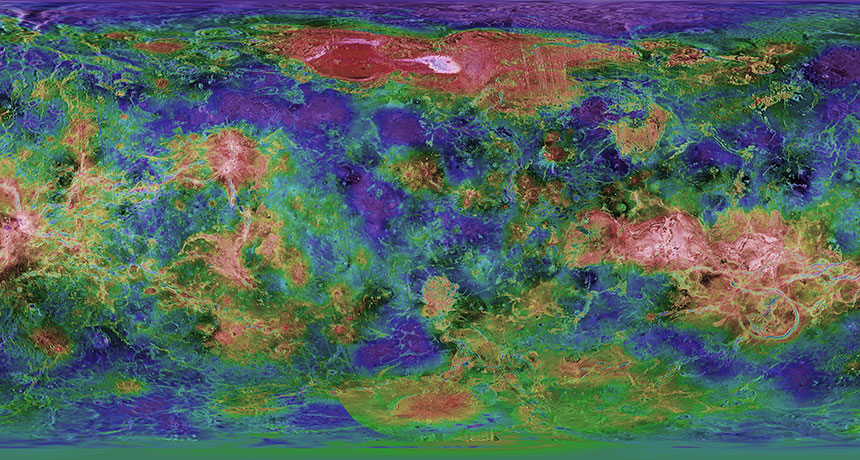
THE WOODLANDS, Texas — Venus’ crust is broken up into chunks that shuffle, jostle and rotate on a global scale, researchers reported in two talks March 20 at the Lunar and Planetary Science Conference.
New maps of the rocky planet’s surface, based on images taken in the 1990s by NASA’s Magellan spacecraft, show that Venus’ low-lying plains are surrounded by a complex network of ridges and faults. Similar features on Earth correspond to tectonic plates crunching together, sometimes creating mountain ranges, or pulling apart. Even more intriguing, the edges of the Venusian plains show signs of rubbing against each other, also suggesting these blocks of crust have moved, the researchers say. “This is a new way of looking at the surface of Venus,” says planetary geologist Paul Byrne of North Carolina State University in Raleigh.
Geologists generally thought rocky planets could have only two forms of crust: a stagnant lid as on the moon or Mars — where the whole crust is one continuous piece — or a planet with plate tectonics as on Earth, where the surface is split into giant moving blocks that sink beneath or collide with each other. Venus was thought to have one solid lid (SN: 12/3/11, p. 26).
Instead, those options may be two ends of a spectrum. “Venus may be somewhere in between,” Byrne said. “It’s not plate tectonics, but it ain’t not plate tectonics.”
While Earth’s plates move independently like icebergs, Venus’ blocks jangle together like chaotic sea ice, said planetary scientist Richard Ghail of Imperial College London in a supporting talk. Ghail showed similar ridges and faults around two specific regions on Venus that resemble continental interiors on Earth, such as the Tarim and Sichuan basins in China. He named the two Venusian plains the Nuwa Campus and Lada Campus. (The Latin word campus translates as a field or plain, especially one bound by a fence, so he thought it was fitting.) Crustal motion may be possible on Venus because the surface is scorching hot (SN: 3/3/18, p. 14). “Those rocks already have to be kind of gooey” from the high temperatures, Byrne said. That means it wouldn’t take a lot of force to move them. Venus’ interior is also probably still hot, like Earth’s, so convection in the mantle could help push the blocks around.
“It’s a bit of a paradigm shift,” says planetary scientist Lori Glaze of NASA’s Goddard Space Flight Center, who was not involved in the new work. “People have always wanted Venus to be active. We believe it to be active, but being able to identify these features gives us more of a sense that it is.”
The work may have implications for astronomers trying to figure out which Earth-sized planets in other solar systems are habitable (SN: 4/30/16, p. 36). Venus is almost the same size and mass as the Earth. But no known life exists on Venus, where the average surface temperature is 462° Celsius and the atmosphere is acidic. Scientists have long speculated that the planet’s apparent lack of plate tectonics might play a role in making the planet so seemingly uninhabitable.
What’s more, the work also underlines the possibility that planets go through phases of plate tectonics (SN: 6/25/16, p. 8). Venus could have had plate tectonics like Earth 1 billion or 2 billion years ago, according to a simulation presented at the meeting by geophysicist Matthew Weller of the University of Texas at Austin.
“As Venus goes, does that predict where the Earth is going in the relatively near future?” he wondered.