Passenger traffic to West Asia routes down, while to central Asia & Europe routes up: CAAC
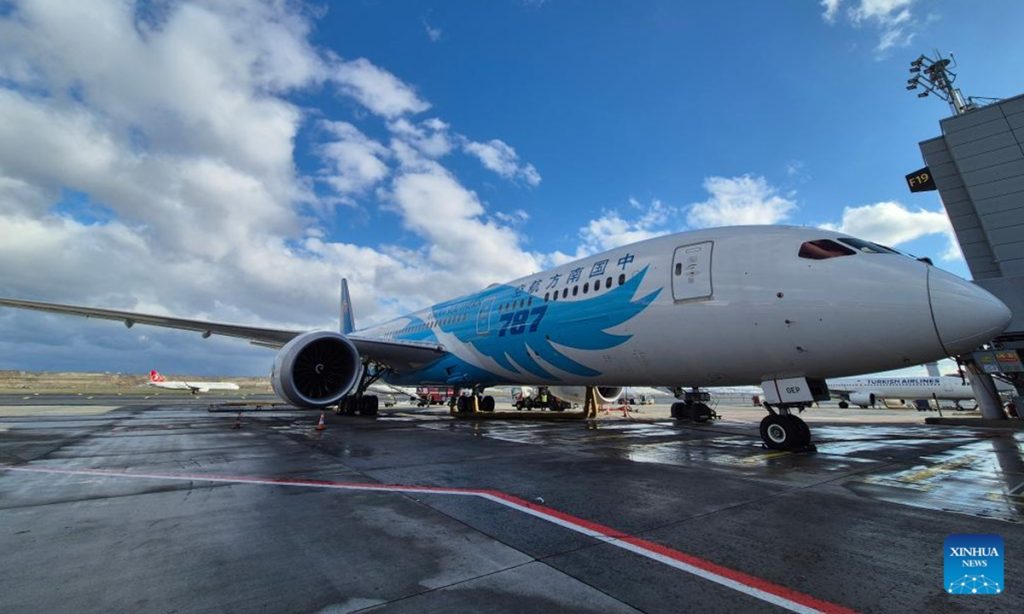
Due to the turmoil in the Middle East, passenger traffic on West Asia routes has significantly declined, while both passenger volume and load factor on routes from China to Central Asia and Europe have notably increased, the Civil Aviation Administration of China (CAAC) said on Wednesday.
The remarks were made following the CAAC's release of the performance for the first quarter of this year, which said that the international market continued to grow rapidly, with year-on-year growth rates of passenger and cargo transport volume on international routes reaching 10.0 percent and 17.6 percent, respectively.
CAAC said in the first quarter, international routes recorded 16.41 billion ton-kilometers, up 17.5 percent year-on-year. The share of international transport in the total reached 38.3 percent, an increase of 2.1 percentage points year-on-year.
In the passenger transport market, the industry has completed a total of 200 million passenger trips. Among them, domestic routes handled 180 million passenger trips, up 6.1 percent year-on-year; international routes handled 20.819 million passenger trips, up 10.0 percent year-on-year.
On Wednesday, China Eastern Airlines launched its Xinjiang branch in Urumqi, aiming to actively explore the development of international air routes from Xinjiang to Central and West Asia.
According to the China Air Transport Association (CATA), since the beginning of this year, the weekly international passenger flight schedule has remained generally flat compared to the same period last year, indicating a stable overall capacity supply, according to the news portal caacnews.com.cn on Monday.
During the May Day holiday, international passenger flight schedules increased by 5.5 percent year-on-year. Flights on trunk routes and major city connections in Southeast Asia and Oceania remain stable, while reductions on some regional routes are the result of market-based operational adjustments.
At present, Chinese airlines are increasing capacity deployment in Europe, Central Asia, Africa, Southeast Asia, South Asia, Oceania, and Latin America, with overall capacity meeting demand, said CATA.
In response to public concerns over the recent reduction in international flight schedules, a representative of the CATA noted that the flight cuts are mainly concentrated on niche tourist destinations in Southeast Asia, low-density regional routes, and a few direct regional routes from secondary cities in Oceania.
This is neither a unilateral industry-wide service reduction nor a large-scale flight suspension, according to CATA. Rather, it represents capacity adjustments made by airlines based on multiple factors under the current international aviation market environment, and falls within the scope of market-oriented operational adjustments by airlines. The main drivers are tight jet fuel supply and weak market demand.
Currently, international jet fuel prices remain high. The average refueling price for Chinese airlines at overseas airports has exceeded 11,000 yuan ($1,612) per ton — more than double the previous level — with prices at some individual airports surpassing 30,000 yuan per ton. The rapid increase in fuel prices has led to a sharp rise in airline costs, making it difficult for some low-cost carriers to sustain regular operations on low-efficiency routes. At the same time, fuel supply at some regional airports is tight, leaving airlines at risk of having no fuel to refill.
On the demand side, it is currently the off-season for tourism in Southeast Asia and Oceania. Load factors on some regional and niche routes remain persistently low, far below the break-even level for profitability.
Data from some airlines show that on recently canceled international flights to Southeast Asia and Oceania, booking rates were below 30 percent. Preliminary statistics indicate that booking rates for Chinese airlines on Southeast Asian routes are around 50 percent, while those on Oceania routes are about 70 percent, placing significant operational pressure on airlines to continue service, said CATA.
Major Asian airlines have reported surging demand on European routes as travelers shun disrupted Middle Eastern hubs, in a shift analysts suggest could persist for some time even after the Iran conflict ends, according to the Reuters on Monday.
Hong Kong's Cathay Pacific Airways, Singapore Airlines, Korean Air Lines and Australia's Qantas Airways last week disclosed robust performances on European routes in March, even as they grappled with a doubling in the price of jet fuel.
On April 17, Willie Walsh, director general of the International Air Transport Association, stated that some parts of Asia have already experienced flight cancellations due to fuel shortages, and warned that if the situation continues, Europe could face a similar dilemma by the end of May, said Reuters.